Monday, September 28, 2015

Freedom Is Not Free

I had a wonderful tour guide in Valley Forge, Pennsylvania. He was passionate about George Washington and about his Christian faith.


He talked about Washington's character; several times Washington had the opportunity to take over the government, and I imagine he would have been a benevolent ruler, but instead he allowed an even better plan to be installed by some other wise men.

Maintaining liberty is more than just having elections. As our government was being formed, people had to decide which powers to give to the government, because an overly powerful leader, though elected, might take away liberty. A concerned citizen during that time said "when a man is at the head of an elective government invested with great powers, and interested in his re-election, [you may know] in what circles appointments will be made; by which means an imperfect aristocracy bordering on monarchy may be established." In other words, an elected president with too much power might choose to give government positions to all his friends and become like a monarch.

If the elected person makes all the decisions, then it will not be too hard to figure out a way to stay in power. Although I become frustrated by the fighting between different government entities, I'm grateful that those different structures keep an eye on each other, especially since it's hard for me to know what things are going wrong.

Back to my tour guide, he connected this political idea to Jesus Christ. Freedom from sin is not free. I know that, when left unattended to, my sins and weaknesses would stop me from progressing. I believe that the wonderful people that I meet have become wonderful, despite their imperfections, because of strength from Christ's Atonement. We are also freed from the bands of death; I believe this because God's prophets have taught it.
A lot of people think of the phrase "there is no such thing as a free lunch" when they think of economics. But I had a free lunch more than once just this week. And the Book of Mormon says "the way is prepared from the fall of man, and salvation is free." Indeed, to me lunch was free, and to us the Resurrection and the path to salvation is free, but that doesn't mean that nobody paid. The economic principle is meant to explain opportunity costs; when we choose something we are inevitably giving up something else. But many things were decided and paid for by others and yet they continue to bless us.
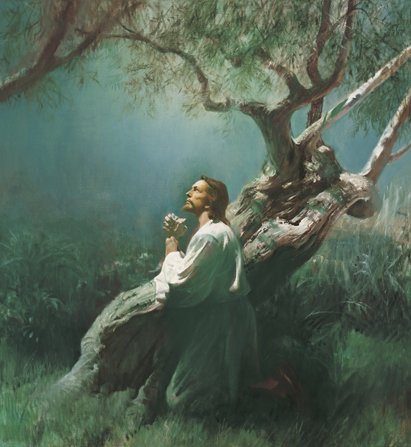
Christ in a white robe, kneeling near a large olive tree, with hands clasped, looking upward.
I am grateful that the founding generation was willing to give up some comfort to fight for our lasting political freedom, and I am grateful that the Savior sacrificed His life for our spiritual freedom so that we may have everlasting life.

Tuesday, September 22, 2015

Mr. President Don't Build This Wall

I went to the Constitution Center in Philadelphia this weekend and heard Ronald Reagan's famous statement "Mr. Gorbachev tear down this wall." Now I know that it's a very different context, but nonetheless hearing that really got me thinking about how harmful it would be to build a wall between the United States and Mexico, and more generally about the benefits of legalizing all the immigrants that want to come.
My Immigration post explains the purchasing power benefits of easier immigrant legalization. Now I'm going to look at some potential political benefits of allowing immigrants.

Competition! I sort of hate being such a competition lover, since I so dislike it on a personal level. But here is an example of when it's beneficial: If a restaurant has terrible food, we can simply switch to another restaurant. In that way, the restaurants that give you the most bang for your buck continue and the others go away. Otherwise, the world could continue with restaurants that nobody really likes. Or think of the labor market; without competition, employees could be stuck with terrible employers for life, because there is no competing alternative employer. These situations probably pale in comparison to being stuck in, say Syria, as an unwanted minority.

When there are high barriers between countries, a country's government has a monopoly over its people; there is no competing alternative place to live. The government those citizens are born to is the only government from which they can hope to receive protection of their rights. Monopolies lower production; in the case of countries, a government can treat its people worse and still exact what it will from the people, at least until the people decide to stop 'buying' and revolt against their government.

Perhaps governments would try harder to make people happy if they knew that those people can leave if they aren't happy. Of course, becoming a migrant is rough, so fortunately people will try to improve their home community before leaving, but what a blessing it would be to oppressed people to be able to leave oppressive situations.

I learned about another example of the importance of accepting immigrants at the Holocaust Museum. There was a window right before the start of WWII during which the German Jews could have emigrated, but most countries (the U.S included) refused to receive so many immigrants.

Rather than imposing democracy abroad, perhaps a more gentle and effective way to help foreign people is to allow them freer movement between countries. With Mexico, our policies might be different if we think about the welfare of not only the Mexicans that are coming, but of those that are staying in Mexico as well. Most immigrants come just to work and live, but let's address the concern that many criminals come in from Mexico. Is there that big of a difference between having a criminal among U.S. citizens and having one among Mexican citizens? Adam Smith points out that one benefit of self-interest (looking after our own citizens first) is that we know our own immediate circumstances better than we know the circumstances of people far away. But I believe that having an open and positive relationship with Mexico is in our own interest; it leads to better trade, a richer culture, greater international peace, and on a personal note, I love associating with the immigrants that I know. Since my mission to Guatemala, I take every chance I can to chat with people who are native Spanish speakers, and many of them are immigrants who are grateful to be here.

Freer movement will allow happiness-seeking individuals to go to the country where they have the greatest chance of success.

Monday, September 14, 2015

Families Are Efficient

Elder L. Tom Perry, a leader in the Church of Jesus Christ of Latter-day Saints, made an insightful statement about families in his last talk given, shortly before he passed away. "No one has ever come up with a more efficient way to raise the next generation than a household of married parents with children." April 2015

My sister and I have talked about how this can be true on a very literal level. She got married about a year ago and has noticed that home-cooked meals for just two people involve a lot of leftovers that can get boring. And as a single college student, it's so much work per person (me) to make a good meal that I do my best eating at restaurants. However, home cooking experiences economies of scale. As you cook for more people, the cost (of time and supplies) per person increases more slowly than the benefits per person, especially with the benefits of warm-hearted giving and receiving among family members.

Another way that families are efficient is that they don't have as much of the principal-agent issue. That issue arises when the principal or owner has one goal, but the agent or employee has another goal. For example, the owner of a restaurant wants to cut costs and get people to come back and refer friends. A waiter may just want a good tip. This could lead to the waiter giving too many free items to customers to cover for mistakes, while blaming other people in the restaurant for problems in the orders. On the other hand, parents usually love their child more than any other mortal, and they are also the ones who make decisions about how to raise their child; there isn't any gap there. Conversely when schools are trusted to raise a child, the school employees are more likely to worry about test scores and miss the principal goal of raising a happy child that becomes a happy adult.

A third way in which families are efficient is through synergy. With a mother and father who complement each other, the accomplishments of the pair exceed the sum of what they could accomplish separately. In my home growing up, I admit that sometimes it was fun when both my parent were out of town for a weekend so that we could order pizza and do whatever we wanted for a bit. But I never liked it when just one parent was gone; their personalities complemented each other's well. I am grateful for a home that created a great balance of play, work, relaxing, learning, silliness, chatting and spirituality.

I don't have 90 years of experience like Elder Perry, but I have also felt that "the family is the center of life and is the key to eternal happiness."

another blog

Sunday, September 6, 2015

Free market not working!?

Well, I am stumped. Despite my usual libertarian ways, I can't really think of a good reason for why I am happy that the Smithsonian museums are free. By "libertarian" I mean keeping government as small as possible while not letting the market fall apart. This means that government will simply enforce laws and such so that private citizens can carry on life peacefully. But the Smithsonian received $819.5 million of federal government money for 2015, and that isn't necessary to keep the market going. So my positive feelings leave me wondering what I could learn from this apparent contradiction in my beliefs.
It could be that I am simply self-interested and happy that since I am in D.C. I receive the benefits of that money that people all over the U.S. are contributing. Or perhaps it is that I don't think that the on average $7 per tax payer really bothers anybody, and most of those people would be happy to donate that much money to such a good cause anyway.

It could also be that there is a positive externality involved, but I am struggling to see the third party that benefits. I bumped into a nice local man who said that he hits up all the museums, and I think that he receives most of the benefit, but perhaps it makes him more jolly and a blessing to those around him, although that logic could be applied to a lot of markets.

I suppose, however, that if museums were run privately with fees and/or donations then museums could be run even more amazingly, so I certainly won't throw the free-market philosophy out the window.

Perhaps what can be learned is that economic theory does not answer all of life's questions immediately. Or that I don't fully understand economic theory. Okay fine, both of those things are certainly true. As things are currently, I am quite happy, and will try to just feel grateful : )

Scriptures about not understanding: 2 Nephi 28:30 we learn a little at a time, James 1:5 ask God
Scriptures about being grateful: Psalms 26:7 wondrous works, D&C 136:28 dance!