Friday, December 30, 2016

Looking Beyond Mental Illness and Opening Your Eyes to it

I am among the wave of people who are becoming aware of mental illness. I am grateful that awareness of mental illness is increasing because it makes me more compassionate towards others and more conscientious of my own mental health.

Most of my experience with mental illness relates to anxiety and depression.

Sometimes I just need to be forgiving and non-judgmental so that a person's mental illness doesn't prevent me from enjoying their overall person. A roommate who is often in his room  doesn't dislike me, and probably appreciates invitations being re-extended at better times. Thus, on occasion it is best to just look past a person’s mental health challenges.

At other times we may be able to directly help a person with their mental health. When we get the chance to help somebody deal with their mental health challenges, listening with love is important. My church's website, lds.org, suggests that when appropriate you could express that you are happy to listen when your friend wants to talk and that a counselor may be helpful too. That way your friend knows you are happy to help personally, and that you know you aren't a professional.

My own mental health has been blessed by talking with my wife, regularly communicating with God, going to the temple, and heading to bed when it’s late and I feel grouchy (instead of trying to solve all my problems while exhausted).

I think I have been blessed with good mental health, but like anybody I experience anxiety and depression in certain situations. I appreciate that my wife and others let me talk through what is making me sad or stressed, and that they love all the rough edges of my well-rounded struggles : )
by TL Bruce

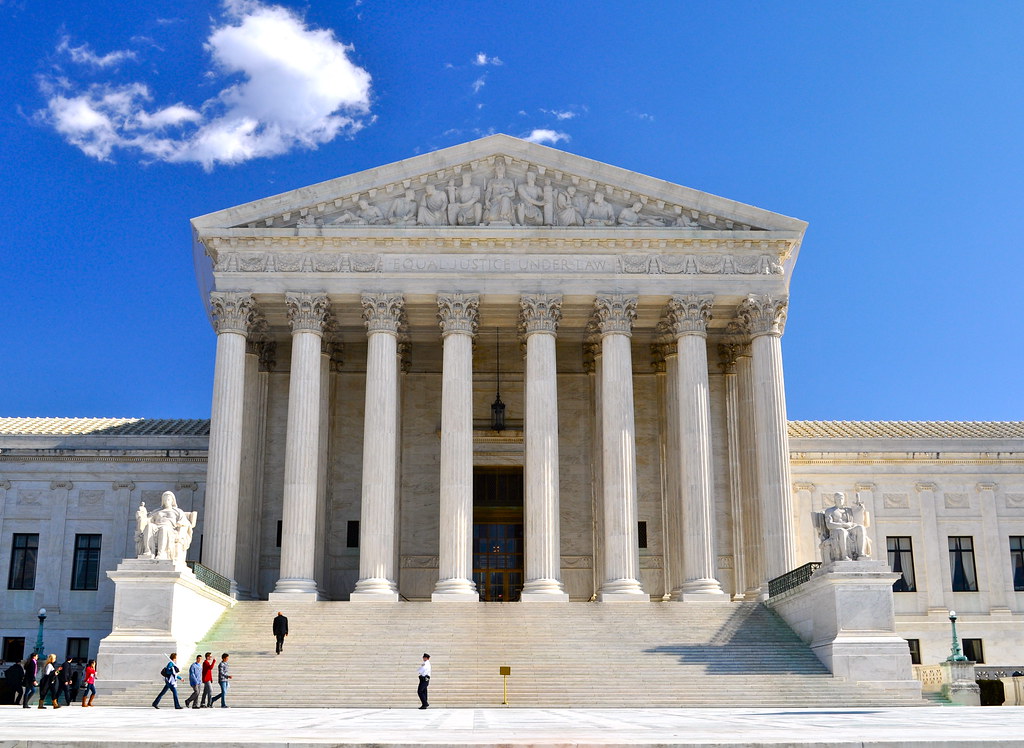
As with all opportunities to serve, I don’t think we should expect the government to solve problems related to mental illness. Our judicial system strives to be objective, and additionally it is hard for courts to determine a person’s mental health. So it may be understandable that sometimes the law won't take into account a person's mental health struggles. Doing so could lead to people making excuses for violating contracts or hurting people's property, behavior that society has a strong incentive to discourage. But as friends and family members, we can always look at a person’s unique circumstances and see how we could help.

Whether you agree with those legal ideas or not, I think you'll agree that it is well worth your personal efforts to understand and be sensitive to the mental health of yourself and those around you. For more inspiration regarding mental health, see Jeffrey R. Holland's talk, Like a Broken Vessel and lds.org/mentalhealth.

Blog's Facebook page here.

Thursday, December 15, 2016

Good Principles -> Poor Outcomes

I'm reading The Intelligent Investor by Benjamin Graham and really liked when he compared investment to playing bridge, even though I know almost nothing about bridge. He said, "When an individual case is to be judged, it is not the result of the play but its conformity with sound principles that marks the competent player. The results do count, of course, both in bridge and in investment--but they must be measured in the aggregate and over the years." The point he is making is that if you follow good principles like buying stocks at low prices and diversifying, then even with randomness in the market, your long-term results will be good.
Image result for eggs in one basket
flickr.com
Similar to how there is randomness in the market, there is randomness in the spheres of law and spirituality.

Law
Occasionally, the sound principle of enforcing laws may lead to an unjust result. For example, there are heavy penalties for making terrorist threats. This makes sense because even when the threat is fake, a lot of resources are put into ensuring that there really is not anything bad that will happen. The federal government may do its reasonable best to inform people that terrorist threats lead to heavy penalties, yet some unfortunate 18-year-old doesn't get it and does a prank call with a terrorist threat. That subsequently leads to thousands of dollars of police labor being wasted in an effort to make sure there isn't a bomb. If that person is not held accountable, then it may be difficult to prevent other teenagers from doing similar pranks which are very costly, and it may inhibit the police's ability to prevent actual terrorism.

Another example is from a real court case, Halbman v. Lemke. In this case a minor signs a contract for a car, beats the car up, returns the car to the seller and demands his money be returned. In this case the court rules that the seller has to give the money back, because minors cannot contract. As unfair as this seems to that seller, it is an effort to uphold the principle that adults should not be allowed to contract with minors because minors are likely to be taken advantage of or make bad choices.
Image result for parent or guardian must sign
flickr.com
Though there are occasional cases that seem unfortunate, by sticking to sound principles of law most people can predict the legal consequences of their actions.

Spirituality
I serve others because of a spiritual commitment that I have with God to do so. Sometimes I don't feel like serving, even after starting. And yet, when I look back at service experiences, like serving a mission in Guatemala, fulfilling church assignments, and participating in service organizations, I can see that "in the aggregate and over the years" service has been one of the most valuable activities I have done. Breathing has also been valuable over the years, but that is much less interesting because I rarely feel opposed to breathing.
Image may contain: 5 people, people smiling, people standing
Long-lasting friendships is one blessing that I have observed from long-term efforts to serve.
A similar principle applies to all spiritual endeavors, such as studying the scriptures, praying, paying tithing, going to church, and more generally, being faithful and repenting. Sometimes we don't get the exact result we want. There are a lot of factors to any activity that could make the experience not so great, but in the aggregate I think we will see we are blessed as we follow sound spiritual principles.

Monday, November 21, 2016

What Good Comes of Repeated Reminders That Can Make Me Busier?

Members of my church, including myself, sometimes complain that too many things are required of us in our limited time.
Every six months I listen to the Lord Jesus Christ's Apostles give inspired and inspiring talks. These conferences are some of my favorite times of the year. However, I can also feel overwhelmed when I am reminded of the many good things that I could add to my already packed schedule. But this unfortunate feeling is accompanied by blessings.
One blessing I have observed is improved marginal productivity. Something that I learned in my basic economics course is that we often experience diminishing marginal productivity. The more time we spend on certain activities (think of ones that we are already spending a lot of time on), the less productive each additional minute spent on that activity becomes.
Image result for diminishing marginal utility
This is especially relevant with whatever we do for a living. The 46th hour that I choose to dedicate to studying (looking over notes for a fourth time, for example) is probably less productive than the 20th hour that I chose to study (listening to a professor or looking at notes for the first time). For this reason, it is helpful to be reminded about the joy of doing something nice for my neighbor instead. Those 30 minutes that I spend meeting and serving a neighbor will probably be more productive than 30 more minutes of studying, given that I am already studying a lot. Hence, I am blessed by hearing reminders of the many good things I can be doing.

This has been a hard lesson to learn. When I was first starting college I often felt like my church leaders thought school was bad and that if I really wanted to be a good person I needed to drop out of school and become a really loving and selfless beggar. After trying to understand this for several years, I no longer feel bad studying. I think studying is awesome and wish I did it more (I should maybe be doing it right now). At the same time, I see that the occasional break that I take from studying (to follow some other counsel) is often very productive.

Not all activities always experience diminishing marginal returns. For example, your first minute trying to understand Chinese (or the law, economics, or calculus) is probably less productive than your 100th minute, because during your first minute you were so lost that almost nothing was sinking in. A similar principle applies technological devices, which over the long-run go down in price because companies get better at producing them.
Likewise with spiritual things, increasing the total amount of an activity can increase the benefit of each additional minute spent in that activity. This helps explain why learning and reviewing the basics is so helpful. If I only spend an occasional hour at church, then that hour's learning will be forgotten. But by consistently partaking of the sacrament (which is how I renew my covenants with God) I more fully have the Spirit, and hence each hour I spend partaking of the sacrament is more productive than if I only partook of the sacrament once in awhile. Some activities are most productive when we do them so much that they become a part of us.


Monday, October 31, 2016

Which legal standard achieves optimal behavior?

Most civil (not criminal) laws are under a negligence standard. This means that you can be sued if you broke some duty that you have or you failed to act reasonably in a given activity. However, some civil laws are under a strict liability standard. This means that you can be sued for any damage you cause merely by participating in an activity, even if you were acting reasonably and the accident was somewhat random. Criminal laws impose a punishment anytime you break a law and are caught.

An example of a negligence standard rule is over medical malpractice. There is a standard that doctors are expected to practice up to, and if they fail they have to pay for the damage they caused. The term medical malpractice, instead of medical maybe-malpractice, implies that some standard has been breached. We think this rule is appropriate because we don't want doctors to be discouraged from practicing because they can be held liable even when they have not made mistakes.

An example of a strict liability rule is owning dangerous animals. If you own a tiger and it tears someone's door down, you will have to buy them a new door, even if you were acting like a reasonable tiger owner. You could be doing everything reasonable to keep your tiger from tearing doors down, and our law will make you fix torn-down doors. Why might this make sense? The economic (and hence best) reason is to reduce the level or amount of that activity. We do want to discourage tiger owning, whereas we did not want to discourage doctors from treating patients in the example above. We don't just want tiger owners to act reasonably (since tigers may still go berserk). We want tiger owners to increase their carefulness to the point that some of them will choose to not own tigers at all. It is not enough that they merely act carefully in their inherently dangerous activities.
Image result for tort law
Activities which are much more clearly and consistently harmful than things like tiger-owning are simply made criminal.

What type of standard exists in the Gospel of Jesus Christ? While spiritual laws have some different goals than tort and crime (for example, obedience to the God's commandments brings positive blessings in addition to just preventing punishment), I think there are some insights we may gain by looking at some similarities.

Many commandments do not try to discourage certain activities, but rather encourage us to act well in the things we choose to do. You could say these have the same goal as a negligence standard of not discouraging the activity itself, but encouraging reasonable behavior as we do those activities. For example, we are commanded to be witnesses of God "in all places that ye may be in." In the words of Shakespeare, "What-e'er thou art, act well thy part." And from what I have seen, the Church doesn't give specific college or career direction, but just encourages us to find something we would enjoy.

I have had a hard time thinking of commandments that try to lower the amount of an activity like a strict liability standard does. Maybe a few examples are to eat meat sparingly and not sleep longer than is needful, but those are pretty uncommon. Perhaps more comparable commandments are ones like sharing the Gospel, serving, and praying, when God is not giving us an exact structure to follow, but He is trying to increase our level of activity in those things.
Some commandments treat an activity as spiritually criminal: killing, committing adultery, lying etc. Heavenly Father knows that in order to be comfortable in His presence after this life, we need to avoid these things, and use the Atonement of Jesus Christ to fully repent and receive forgiveness when we mess up.

To review, a negligence standard's purpose is to incentivize us to behave well in whichever activity we choose, strict liability's purpose is to change our level of activity, and criminal laws try to eliminate an activity altogether.


Fortunately, with all spiritual laws, I know that Jesus Christ helps us to succeed and blesses us immediately as we live in accordance with those laws.

Thursday, October 20, 2016

3 Tips for Good Writing

I don't want you to think (that I think) that I have writing wisdom to share, so I am saying upfront that this post is about me pleading for help, not giving out writing advice.

In my last semester before graduation from BYU, my writing professor said all he wanted us to remember for writing well was:

1) Know your reader;
2) Tell the truth; and
3) Don't be boring.

To improve this blog, I want to get to know you (I don't need your name, just your main interest in reading this or any blog), to know when you think what I write is bogus (or especially truthful/insightful), and to know what you think is boring (or especially interesting).

If this is the the first time you have read this blog, read one other post and then give me feedback!

Now use this link to answer the questions! https://goo.gl/forms/SUfzOjdMe4v4Fnot1

Thanks so much!

Image result for writing
wikipedia.org

Thursday, October 13, 2016

Drugs

Should marijuana (or some other substance) be legalized? If the cost to society of legally allowing marijuana is less than the cost of maintaining a ban, then I think so. It is true that lowering the barriers to obtaining marijuana will lead to a higher quantity demanded by reasonably rational people, which I do think hurts society. But it could be even more harmful to enforce laws with expensive police operations (or not enforce laws, which disturbs the rule of law). Figuring out those costs seems harder than I want to figure out right now, so I hope that some experts figure it out and that lawmakers make good choices based on their findings.
Image result for marijuana
drugabuse.gov

However, I don't think that the arguments for and against legalization of marijuana are nearly as important as promoting a cultural change in the way people view the personal choice to consume substances which reduce a person’s control of their behavior.

I religiously abstain from certain harmful substances, including unprescribed drugs and alcoholic drinks. But I share enough values with society at large that it is still surprising to me to see how casually people view alcohol. Occasionally people that I am very fond of will joke about alcohol as a way of having fun or coping with stress.

While I know a lot of people have fun or cope with stress without running into bigger problems, I don't think that people who crash while drunk or start mistreating their families ever had those bad results as their goal when they started drinking. So I hope that these risks are considered before the practice of drinking is adopted.

Additionally, there are less noticeable consequences that arise from more moderate drinking, like missing out on coping with stress through reliance on loved ones or having fun through fully cognizant silliness, music, or discussion.
Thomas S. Monson, President of the Church of Jesus Christ of Latter-day Saints, invited us to "care for our bodies and our minds by observing the principles set forth in the Word of Wisdom, a divinely provided plan." I am grateful for that plan and have been very blessed by it, and I invite you to learn more about it if it's new to you.

Wednesday, September 28, 2016

3 Reasons for 1 Big Tax

I'm going to explain how a tax on a broad base is better than multiple taxes on narrow bases, and also how focusing on a broad commandment is better than focusing on various narrow commandments.


One big uniform tax on something that applies to a lot of people, like property, income, consumption, or all sales, is more efficient than many varying taxes. For example, an income tax (even if it is progressive) that gathers one trillion dollars is better than a 4% tax on blueberries, 8% tax on Chinese imports, 3% tax on French imports, etc. which gathers one trillion dollars. I'll explain 3 reasons for this:


1. The most basic economic reason, though also the hardest to understand, is that when one broad base is taxed we don't have a lot of substitutes. If apples and blueberries have the same tax, then I'm not substituting apples for blueberries because of a difference in tax rates. Due to this lack of lower-tax substitutes, we purchase things we normally would in the amounts we normally would. And with this less distorted consumption, we are buying things for which there is the greatest possible economic surplus, purchasing things according to their cost and the utility or joy they bring us.
Image result for grocery shopping
flikr.com
2. Another reason is transparency about how much the government is taking. Seeing that the tax rate you pay moved from 20% to 25% makes it clear that government is growing. On the other hand, a jumble of changes like higher taxes on some imports, lower income tax, higher sales tax etc. makes it hard to hold Congress accountable for its overall performance. Of course, you can look up total US Government spending, but people often don’t think to without seeing its direct impact on their income.


3. My last reason for one big tax is that the government cannot manipulate as much, and so it prevents corruption. If the government is allowed to lower taxes on dairy and increase taxes on sugar, then it has the power to get an industry to do what it wants, such as fund a certain politician's campaign. One big tax doesn't give the government as much power to pick favorites.
Image result for government corruption
wikipedia.org
How does this relate to focusing on broad rather than narrow commandments? Love is the broad commandment that we should follow, and all the other commandments should fall into place as we obey that commandment. President Thomas S. Monson said "love is the very essence of the gospel, and Jesus Christ is our Exemplar." I believe that if we make this our main focus, then our other goals will lead to lasting success. Without this overarching goal, we may find that we are doing some bad substituting, like neglecting family to improve our education or vice versa. Doing what Jesus would do and following promptings from the Holy Ghost is the sure way to get us where we want to go.
Image result for greatest commandment
flikr.com
Of course, specific goals of varying time frames will help us to achieve our long-term goals. But I have found that I get a lot of peace and direction throughout my flurries of studying and other activities if I reflect on the broader commandment to love God, and feel His love, either through reading the scriptures, attending the temple or church, and praying.

Summed up, just as one big broad tax is more efficient and makes clear what the overall tax system is doing, focusing on the big broad commandment of loving God is more efficient and makes clear our overall spiritual progress.


Sunday, August 14, 2016

Why death?

Sometimes I worry about death. Nobody especially close to me has died, but I wonder if that makes it even more ominous. Once at work, I was dusting and just started worrying so much that my wife would get in a car accident or something that I started to cry (it didn't help that I was listening to the song "How Can I Live Without You?"). On other occasions I may not be worried about the imminent future, but I realize that we'll all die someday and that's enough to make today not so great.
Loss and Grief by Patrick Emerson
But as I have learned with all opposition (I sort of hate admitting this, because I'm still not a fan of opposition), there is a lot that I can learn from it. If there were no death, then I don't think I would value people as much; I would take them for granted. The idea of a person dying makes that person vividly real and important to me.

You can estimate the economic value of a life. Look at two jobs which are similar in every regard except 1) pay and 2) risk of death. Next, multiply the hourly wage difference by 1 over the difference in the percentage chance of death. Multiply that number by the number of hours they would otherwise live. That gives you an estimation of their life's economic value according to what they demand in compensation for reduced safety. If it takes 5 dollars more an hour for a person to take a riskier job, all else equal, then that difference in safety during that hour is valued at 5 dollars, and that information can be extrapolated to estimate how much a person values the rest of their life.

This calculation bothers some people. Why? I think because we recognize that there is a value in people beyond this life, evidenced in part by the pain associated with the death of loved ones.
The depth of our feelings also indicates that there is an afterlife. I experience non-physical feelings, spiritual feelings, when I am with my family and/or talking about God and His plan for our families.  I have felt such happy and tender emotions towards my family that I don't think that the death of my body could make those spiritual feelings go away.
Perhaps my greatest comfort with regard to death is my overall testimony of God. I know that He lives and loves us, that He answers our prayers and has a plan for our eternal selves. While I still worry a lot, I know that I can find joy by anxiously serving God in this life and in that way, I can find a fullness of joy in the next life.

Saturday, August 6, 2016

My Political Weighted Points

Sometimes when we make decisions we think about possible outcomes but we don't think about how likely those outcomes actually are.

I am going to write out the potential differentiating costs and differentiating benefits of each candidate, multiplied by how likely that cost or benefit is to occur/have a real effect. The cost and benefit numbers represent how big of a deal I think those attributes are, assuming that they happen. By "differentiating", I mean things that are unique to each candidate. (For example, I won't talk about the benefits of them being U.S. citizens, since all of them are. Also, rather than giving negative points to Clinton and Johnson for being pro-choice, I give Trump positive points for being pro-life.)

I realize that the cost and benefit numbers and the probabilities are not founded in data or anything besides my own impulse, so just try to use what I'm doing as one option for how to think about analyze more specifics of your own opinions.

key: bold=benefit, red=cost, blue=results
Donald Trump: directness (50*.8) + said people who are happy are family people (100*.2) + pro-life (300*.4)  + Mexican wall (-125*.5) + his concerns about unfair trade (-50*.6) + not aiming to reduce number of prisoners (-15*.9) + wants to keep out Muslims (-125*.2)
positives/benefits: 180
negatives/costs: -131
total: 49
Hillary Clinton: foreign affairs knowledge (100*.9) + religious (150*.6) + predictable (90*.8) + wants to help people (60*.85) + pro-gmo (60*.85) + email issue (-10*.1) + doesn't want to reduce regulation on businesses (-100*.9) + would appoint liberal judges (-100*.8)
positives/benefits: 303
negatives/costs:  -171
total:  132
Gary Johnson: wants to reduce the role of the Federal Government in education (125*.95) + will veto unbalanced budgets (150*.8) + talks about the constitution (150*.9) + won't win (-100*.99)
positives/benefits: 373.75
negatives/costs: -99
total: 274.75

You'll see that Gary Johnson only had one negative/cost item listed. It isn't that I think Gary Johnson is perfect besides not winning, it is just that his flaws that I see happen to be shared with another candidate. Thus, this is his only differentiating cost.

And now for my huge list of disclaimers. I have done this post as a fun way to take into account everything I think about them. I feel a little uncomfortable giving Hillary Clinton points for religiosity, because I don't think there should be a systematic religious test for government officials. Nonetheless, my number one criteria for a presidential candidate is that he or she be just, honest, and good (Doctrine and Covenants 98:10). While religious people do not always meet those requirements, religion helps, and it especially helps with not being antagonistic against religion.

I'm also hesitant to take points from Johnson for not winning, because sometimes it is good to support a less heard voice. But I suppose that votes for him are less well publicized and hence will make a smaller impact.

I understand that I am mixing a quantitative approach with my qualitative feelings, which doesn't lead to accuracy. It might be better to use dollar estimates of the efficiency gains and losses of each candidate, but that would require more data and brains than I have. And perhaps a nice drawing would better depict their qualitative characteristics, but I'm not that artistic. But hopefully you can still be inspired to think hard about the candidates by seeing these topics next to fairly arbitrary numbers ; )


If any cost or benefit mentioned here sparks your interest or disagreement, please comment so that I can research it more and do another post on that topic!

Monday, August 1, 2016

How do Law, Economics, and God make us free?

The Rule of Law creates stability, meaning it creates a society in which your actions will have reasonably predictable consequences. Without the Rule of Law, or without the laws of a country following predictable and non-discriminatory principles, people live in fear of the government and are hardly able to focus on their own goals.
A lack of the Rule of Law could explain the chaos and lack of development in some parts of Africa. Likewise, a lack of the Rule of Law can lead to the rule of tyrants or dictators, like Pol Pot in Cambodia who targeted people who were educated. Both of these examples demonstrate how a a lack of the Rule of Law leads to a lack of stability. In turn, this unstable system reduces an individual's incentive to invest in education or other pursuits since their investment won't be able to develop.

So Law gives a stable platform from which people can set and pursue their own goals.

Economics is a platform to understand how scarce resources can be allocated to help us pursue our goals. Economic efficiency maximizes the goods and services available for society to use. More bread, gasoline, cleaning services and everything else that has a price can help us achieve our goals if we use them right. Food, shelter, clothing, transportation, and administering programs all require work. Hopefully we enjoy some aspects of the work, but that doesn't change the fact that we'd like to accomplish some of this mundane work with less time and resources so that we have more for other things. A good economic system will produce the goods and services we need and want for the lowest cost possible. This is done through creating optimal personal incentives (rewarding people's hard work) along with allowing specialization (allowing trade).

So basically, economics lets us do things like produce food, and thus we are free to live and do something besides be dead.

While I do believe that God expects us to learn a lot about freedom from academic fields, when we turn to Him, His love supersedes the principles of law and economics as we normally think of them.

"Now, if a man murdereth, behold will our law, which is just, take the life of his brother? I say unto you, Nay. But the law requireth the life of him who hath murdered; therefore there can be nothing which is short of an infinite atonement which will suffice for the sins of the world." (Alma 34:11-12)

To me this means that though I'm not good enough to be saved by my own adherence to righteous laws, the Savior loves me so much that He will still save me, if I follow His path of faith and repentance.
God also overcomes typical economic problems. He told his Apostles to "Take no thought for your life, what ye shall eat, or what ye shall drink; nor yet for your body, what ye shall put on. . . Consider the lilies of the field, how they grow. . . even Solomon in all his glory was not arrayed like one of these." (Matthew 6:25-29)
I have seen blessings in my own life that are evidence that God is taking care of me, forgiving me even when I don't deserve it and providing what I need to keep pursuing my dreams.

Understanding how good principles of law and economics function has helped me to understand some of God's dealings, and to better appreciate the miracles that He performs which I don't fully understand.


Sunday, June 26, 2016

Humility

One of the qualities that I most seek in friends is humility. Perhaps this is just me wanting feel better about myself and not wanting to be intimidated. But I also think there is a special connection that is possible when two people are willing to learn from each other.
Unfortunately, wanting to be right is often more common than humility. This is understandable, since if I knew my view was wrong and yours was right then I would probably just change my view.

C.S. Lewis looks at the difficulty of achieving humility in a humorous light. In The Screwtape Letters the senior demon says,

"All virtues are less formidable to us once the man is aware that he has them, but this is especially true of humility. Catch him at the moment when he is really poor in spirit and smuggle into his mind the gratifying reflection, “By jove! I’m being humble”, and almost immediately pride—pride at his own humility—will appear. If he awakes to the danger and tries to smother this new form of pride, make him proud of his attempt—and so on, through as many stages as you please. But don’t try this too long, for fear you awake his sense of humor and proportion, in which case he will merely laugh at you and go to bed."

Despite the many obstacles to being humble, I will mention some examples of people achieving humility through service.

Leaders in the Church of Jesus Christ of Latter-day Saints have been great examples of humility to me. Though they have authority over a certain group of people, they act as servants, both to Jesus Christ and to the people they are given charge of.
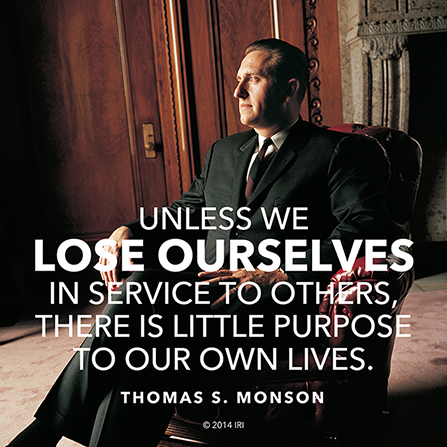
An informal portrait of President Thomas S. Monson combined with a quote by him: “Unless we lose ourselves in service … there is little purpose to our own lives.”
I have also seen people like my mom who keep serving even when what they do for their kids or others is not received graciously. Rather than spending resources on things that will increase social standing, she serves in ways that receive less worldly recognition.
Jesus Christ is the Son of God, and He came to Earth to live as a mortal. He suffered persecution from those who should have been His friends, and He kept loving them and fulfilling the mission that His Father had given Him. I know that He came to earth and suffered everything that we suffer and that today He comforts and guides me.
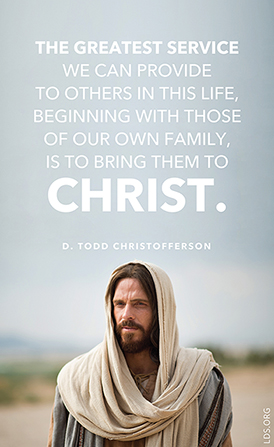
An image of Christ with a text overlay quoting Elder D. Todd Christofferson: “The greatest service we can provide to others … is to bring them to Christ.”
I suppose that sometimes we need to stop worrying about our level of humility and just keep serving and loving as best we can, so don't study this blog quite as much as you study most of my blogs ; )

Tuesday, May 24, 2016

Transgender Decisions

I have been listening to talk radio on my way to work here in Utah lately, and it has at least kept me informed about what some of the big topics are in the news.

Recently, the Department of Education and the Department of Justice gave some guidelines which encouraged schools to allow transgender children to use whichever restroom or locker room they choose. I don't think that President Obama is necessarily being a tyrant, or that children will be abused. (After a couple cases of abuse, I imagine that even most current supporters of the new guidelines would have a change of opinion.) However, I do think the guidelines send a very powerful and detrimental message to children.

This decision of gender is occurring at an even earlier age than the decision of marriage; it is occurring before children learn about who they are in a family setting. Even if you think it is appropriate for adults to decide to have a same-sex marriage, five years old is pretty young to make decisions that can dramatically lessen a child's likelihood of having their own children in the future. Choosing one's gender is one of many decisions that I don't think should be made before one's frontal lobe is fully developed or during the confusing changes of puberty.
While children are still making some basic decisions about morals, principles, and problem solving, they are being told that it is okay to change gender as soon as they want. Changing their gender at this time may seem to fix certain problems, but it does so with great future costs which society is inappropriately discounting.
I believe that what is best for children with gender confusion is to be told that it is okay to have that confusion, that they are still amazing, and that they can work through their confusion without changing gender.

Giving children affirmation that their gender of birth is part of God's plan will give them more long-term confidence to overcome obstacles that could reduce their probability of having a happy family.


Monday, April 25, 2016

Zion

C.S. Lewis discusses how the Moral Law determines when and how to play the notes on the piano of our instincts. Meaning, evolution gives an explanation for our instinct to strive for our own survival (individuals who don't strive for survival die out). Evolution also gives an explanation for our herd instinct, our desire to help others within our species (species of creatures who don't help each other, or try to kill each other, die out).

How is it decided whether we heed the selfish instinct or the herd instinct? C.S. Lewis argues that it is the Moral Law that often tells us that the selfless choice is the better one. "The Moral Law tells us the tune we have to play: our instincts are merely the keys."

In more spiritual terms, we have a drive to create Zion. We have an innate desire to trust and be trusted and hence have intimate relationships.

The Book of Mormon says "if they should have charity they should not suffer the laborer in Zion to perish. But the laborer in Zion shall labor for Zion; for if they labor for money they shall perish" (2 Nephi 26:30-31).

I have seen this in my own situation in Provo, Utah. Those who live around me want to do well in school and someday make money, but they put being kind and serving in the Church first. I think that makes our little part of the world a beautiful place to live in.

God knows that for us to have lasting success we need one of our top priorities to be Zion, a society of people who want to help each other. I believe that striving for this will lead to more individual and community excellence.

Sunday, April 10, 2016

Religious Freedom Laws and Gay Rights

Recently some of the states in the South have passed bills which protect religious freedom. Most people presume that the purpose of these bills is to ensure that religious people won't have to offer services for same-sex weddings or support homosexual activity if it violates their conscience.

One particularly aggressive interviewer on CNN interrogated a woman who didn't want to offer services at a same-sex wedding. He asked her if she would serve to somebody who had violated one of the ten commandments, like committing adultery or not honoring their parents. She said yes, and so he asked what the difference was. Under pressure, she said it just seemed different to her and had no other explanation.


However, there is a viable explanation for why serving at a gay wedding is different than serving gay couples in general. Supporting those events is more closely connected to supporting certain behavior, rather than just supporting people. A better comparison for that interviewer to make would be serving at a party that celebrates adultery or a party that celebrates dishonoring one's parents. These businesses would not condone that. They may want to help gay couples, but according to their beliefs, that would mean that they won’t encourage them in homosexual activity. The exchange should not happen from an efficiency standpoint either, since the cost to the firm (including the cost to their conscience) exceeds the willingness to pay of the gay couple.


The current gay rights discussion is also frequently compared to the civil rights era for African Americans. However, withholding service from people based on who they are is much different than withholding service based on what the service is.

Someday I would like to be a public defender. I think that it would be very fulfilling to help people, even guilty people, to be put in the most free position that our laws allow. But of course this desire does not extend to me wanting to support anything wrong that they have done. Some people don’t believe business people who say they love gay people but don’t want to serve at their weddings; yet society does believe that public defenders care about the accused without supporting their crimes.


Referencing Jesus' love for the sinner but not the sin is not just an excuse of these business owners to avoid serving gay people. Many really are happy to serve gay people if it does not involve supporting homosexual activity.


People with stronger religious consciences have been less likely to join in the mocking of homosexuality, even when mocking it was more common, which was the case even just ten years ago. Yet now that their conscience tells them to withhold support from an activity that they find morally wrong, they are sometimes labeled as the worst discriminators. While I am not sure about the answer to the legal dispute, I think that an accurate view of those opposed to gay marriage will lead to better policies, and hopefully we can also work to have an accurate view of those who support gay marriage.

Sunday, April 3, 2016

How sure should we be?

O.J. Simpson was found not guilty of killing his wife in a criminal case and yet he was found liable for her death in a civil case. This is because the burden of proof is different in criminal and civil cases. The burden of proof is the responsibility (burden) of giving evidence (proving) that what you are saying is true. If you don't have any of the burden of proof, then as long as the other side doesn't do a good job of proving then you get what you want. In criminal cases the state must show that it is beyond a reasonable doubt that a person is guilty, but in civil cases (suing-related cases, involving money not jail) the plaintiff (the person suing) only needs to show that a preponderance (over half) of the evidence indicates that the defendant did what they are accused of. So it isn't unreasonable for there to be enough evidence to find someone "not guilty" in a criminal case but "guilty" in a civil case.

Though we might not like that O.J. Simpson didn't go to jail, it is comforting that the state can't put me in jail simply because there is some random evidence that makes it look 51% likely that I commit a crime. We generally think it is better to occasionally let a guilty guy off than to occasionally put someone innocent in prison (though I could finally find time to write a book if I went to prison).

The point of all that was to show that it matters who has the burden and how high the standard of proof is. Now I'll talk about how that applies to government programs and to keeping God's commandments.

With regard to implementing government programs, I believe that the burden of proof should be on those advocating the program. Those who are advocating an expansion of government will tend to recognize and feel the benefits of the program more clearly than they recognize the costs that are imposed on everyone in their country as a result of the increased bureaucracy and taxes.

This doesn't mean that advocates of government programs are always wrong, but that we should expect evidence that shows that it is really likely that the program will be effective before we implement the program. Unlike most organizations and individuals, government is forceful, and so we should expect more than 51% certainty before expanding its power. For example, there are a lot of ways that people can become educated, ways that don't involve extra taxes, and so I think that it should be very clear that additional funds to public education will work before the funds are given. The lack of clear evidence that increasing funds to public education always works makes me wonder if we are too quick to accept the implementation of more of those programs.


When we are deciding whether to live our lives more in harmony with God's teachings, what is the burden and standard of proof? How proven does a commandment need to be before we decide that it is worth doing everything I can to live it? Do I need to prove for myself that the commandments are meant for me, or does God need to prove it to me?

I have never regretted an attempt to put my life more in harmony with God's teachings, even when it has required some sacrifice. Deciding to take time for God and swallow my pride has always brought me peace, expanded my knowledge, and created deeper relationships in my life.

It is important to ask questions so that we are not misguided, but expecting that every commandment will make sense beyond a reasonable doubt may not make sense if we already have a deep testimony that God loves us and wants what is best for us.

This past week I had to decide whether to prepare for and be attentive to a general conference that my church had. I really was not sure that doing so would pay off, and had to decide to prepare and go despite God not proving to me the importance of doing so. In God's goodness, He blessed me with great spiritual knowledge during the conference.


I know that God lives, and that by pressing forward (going to church, keeping the commandments, etc.) during times of trial we will learn far more than if we always place the burden of proof on God.


Sunday, March 6, 2016

America's Greatest Asset


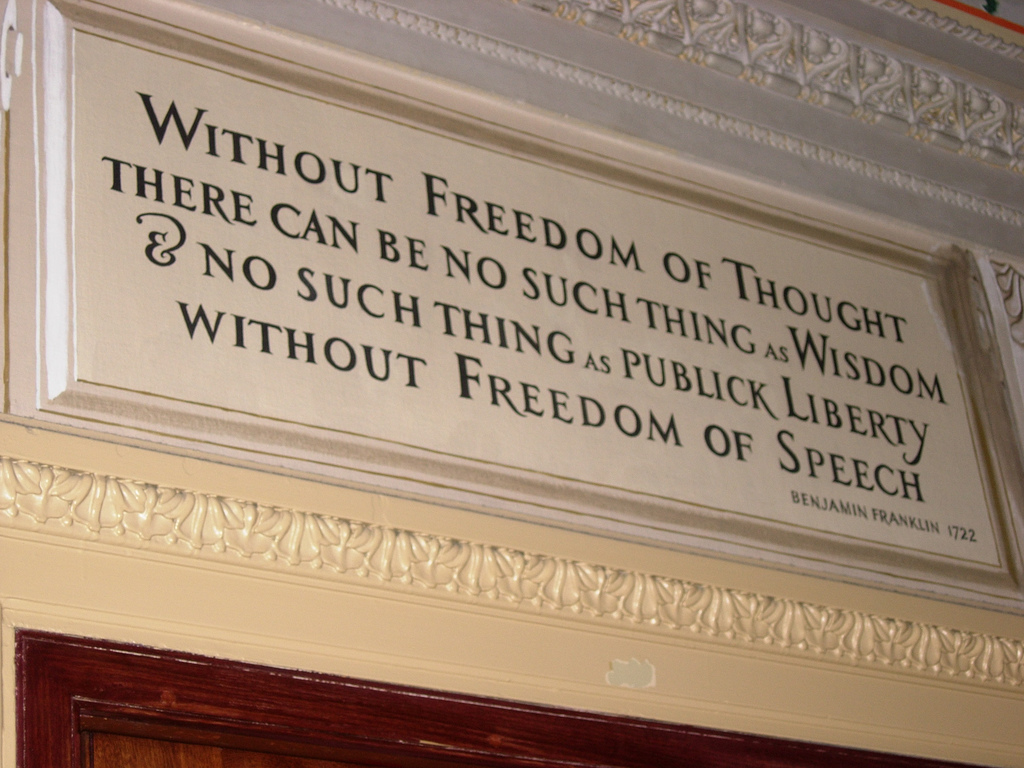
America’s greatest asset, in my opinion, is the security that we feel in sharing our beliefs without repercussions from the government or other forces.

Though we may complain about the battles that we see between parties and branches, such as the President and Congress and the Supreme Court, this open discussion sets the example for the American people to know that they are also free to comment on acts by the government. With our self-criticizing government, efforts to shut down citizen-based criticism would seem absurd.
This asset is what gave Americans the opportunity to speak out against slavery, political machines, wars, monopolies, segregation, and immorality. It gives Americans the opportunity to speak in favor of service, religion, kindness, and other good things.
The hands of a young woman with a white watch giving a blue hardback Book of Mormon to another young woman sitting on a couch.
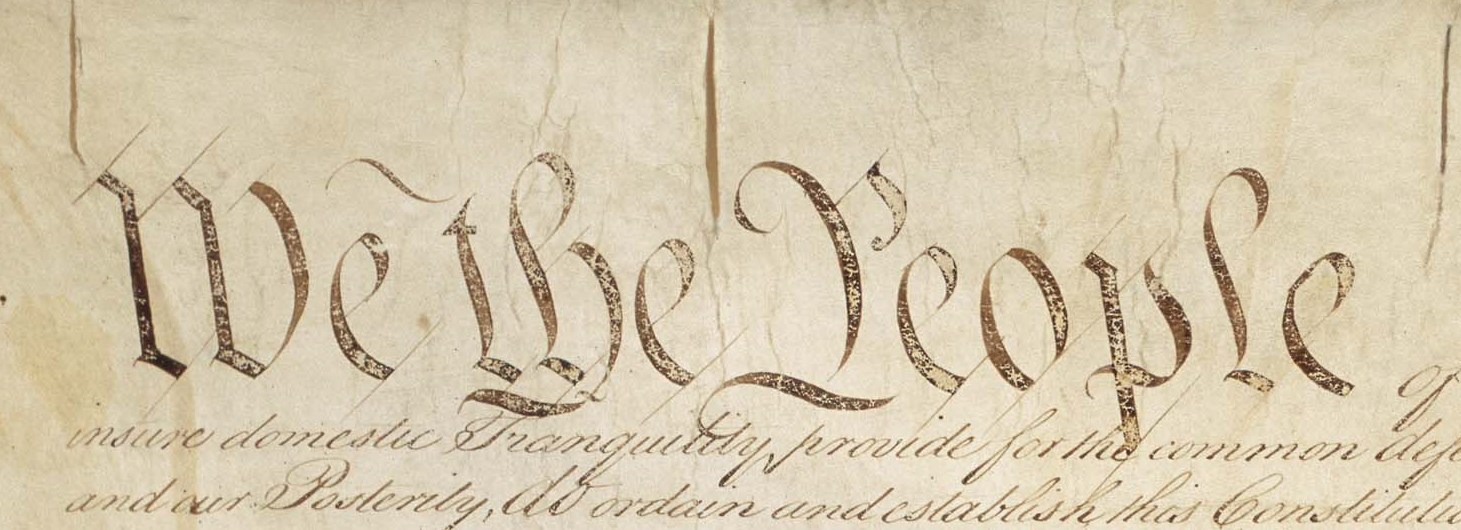
Perhaps the clearest defender of this asset is the inspired Constitution.

We owe some respect to the Constitution, even when circumstances tempt us to ignore it.
It is not by coincidence that the Constitution has protected us from tyranny for so many years. The Founding Fathers knew about tyranny through their experiences with England. Some may say that England didn’t really repress the colonies, and I might agree, but the relative freedom that colonists enjoyed increased their understanding even more. 

They remembered the time period when England had its last tyrant, James II (late 1600s), they knew what it was like to be almost completely free from the Crown’s influence (in the early 1700s), they knew what it felt like to have the government infringe on their daily lives (1760s and 1770s) and they knew what it was like to have a near-anarchic state under the weak Articles of Confederation (1780s). Thus as they wrote the Constitution, they had in mind a good balance of liberty and order. This led to the separated powers which prevents tyranny and the First Amendment which explicitly protects free speech.

Sunday, January 24, 2016

When Duty Is Best

An assignment in my English class is to read 20 minutes of unassigned pleasure-reading six days a week. As I was reading "The Theory of Moral Sentiments" by Adam Smith I got some cool insights into the motive of duty.

Everything we do has a complex variety of motives, and I think our hearts are better than we sometimes feel. However, Adam Smith has some insights into how we might make our motives a little more suitable to our overall goals of helping out in society. He says that gentle actions, such as expressing love, being generous, visiting the sick, and saying thank you should be done because of the feelings that naturally occur within us. This helps people to feel the affectionate feelings that we have for them.
A peach and white background combined with a quote by Elder Jeffrey R. Holland: “May we live by faith.”
On the other hand, he points out that duty plays an important role in keeping us consistent. Being disciplined and even strict is sometimes necessary for the long-term good, but should be done with some level of reluctance. It is more harmful than necessary, for example, if a punishment is given with pleasure or disinterest. Additionally, duty can help us to be consistently honest, even when it hurts our pride for a brief moment.

A more economic application of this idea has to do with the common property problem. When nobody owns a certain property, then people use its immediate benefits too quickly and don't invest in making the property more valuable in the future.
A blue and white graphic with a quote by President Ezra Taft Benson: “A father’s duty is to make his home a place of happiness.”
I will compare a commonly owned property to our character. Some parts of our character we do not develop unless duty to God reminds us of the long-term private benefits that we can achieve by investing. On the margin, our impatience will make it seem that being honest in every situation might offend, but by investing in a reputation of being honest, future benefits of being trusted far outweigh the perceived benefits of one little lie (which will no doubt turn into more lies). Likewise, exercising discipline of any sort yields long-run benefits which are not immediately visible.

With other aspects of our character, the benefits to ourselves and those in our immediate vicinity are apparent. For example, expressing love and being generous immediately bring warm feelings to the giver and receiver. Such actions are most beneficial when they stem from affectionate feelings, and not just from personal duty or an interest in the distant future.